14 Jun 2026
Home Wine Tasting Guide for Better Sips
A home wine tasting guide for beginners and curious drinkers. Learn what to notice, how to compare bottles, and build confidence at home.
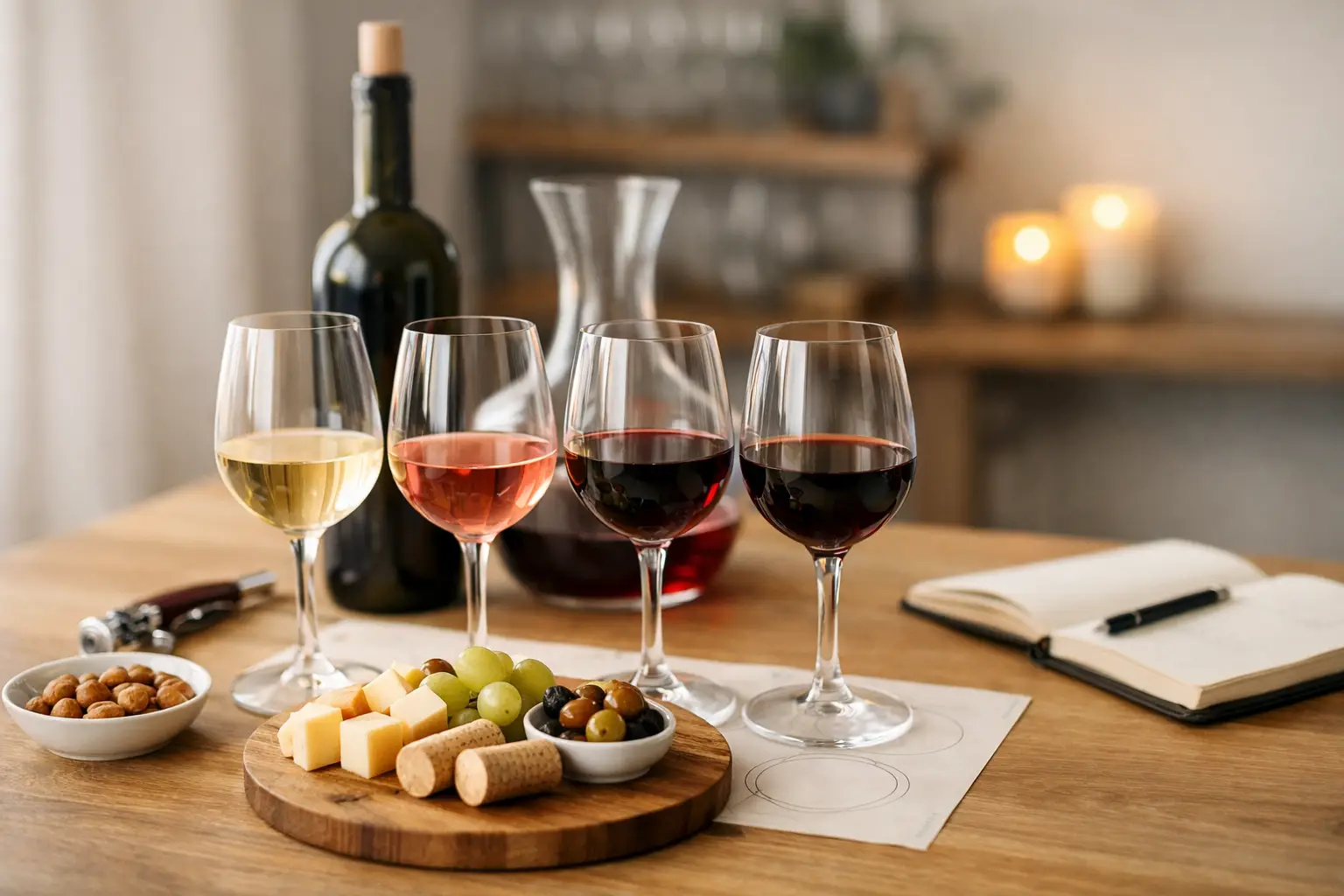
A good bottle can feel wasted when all you can say is, "I like it" or "I don't". That is exactly where a home wine tasting guide helps. Not by turning your kitchen table into a judging panel, but by giving you a simple way to notice more, describe more, and enjoy what is already in your glass with a little more confidence.
The useful version of wine tasting at home is not about performance. It is about slowing down enough to catch the difference between fresh and ripe fruit, soft and grippy texture, a short finish and one that lingers. Once you know what to look for, even an ordinary midweek glass becomes more interesting.
Why a home wine tasting guide works
At home, you remove most of the pressure that makes tasting feel intimidating. There is no need to impress anyone, no rush to comment quickly, and no expectation that you should know the right answer. You can taste, pause, taste again, and change your mind.
That matters because tasting is learned through repetition, not talent. The more often you notice aroma, texture, flavour and finish in a calm setting, the easier it becomes to recognise patterns. You start to remember that one Sauvignon Blanc felt sharper and more citrus-led than another, or that a Merlot you enjoyed had a softer, rounder mouthfeel than a firmer Cabernet Sauvignon.
A home setting also makes comparison easier. You can revisit a bottle the next day, pour two wines side by side, or test whether food changes what you notice. Those small moments build better tasting language than memorising formal terms ever will.
Set up your space before you pour
You do not need specialist equipment, but your setup does affect what you notice. Start with a clean glass with enough room to swirl. Avoid strong cooking smells, scented candles, and heavily fragranced hand soap just before tasting. If your room smells of garlic bread or washing powder, the wine has to compete.
Light matters too. Natural daylight is helpful if you have it, but a bright neutral light works perfectly well. You want to be able to see the wine clearly without turning the experience into a laboratory exercise.
Temperature is one of the easiest things to improve. Very cold white wine can hide aroma and texture. Overly warm red wine can feel loose and alcoholic. As a rough guide, most whites show better slightly cool rather than fridge-cold, and most reds are more balanced a little below typical room temperature. Sparkling wine likes a chill, but even then, if it is ice-cold, you may miss some of its character.
How to taste wine at home without overthinking it
The simplest structure is to move through sight, smell, palate and finish. That sounds formal, but in practice it is just a way to give your attention somewhere to go.
Look first
Hold the glass against a light background and notice the colour and clarity. Is it pale lemon, deep ruby, or something in between? You are not trying to prove expertise here. You are simply training your eye to notice whether a wine looks light and bright or deeper and more concentrated.
Sometimes appearance hints at style, but not always. A darker wine does not automatically mean a better wine, and a pale wine is not necessarily delicate. Treat appearance as the opening clue, not the verdict.
Smell before you sip
Swirl gently, then take a short sniff. Then another. The first thing you notice is often broad rather than precise: fruity, floral, earthy, spicy, fresh, creamy. That is enough. Specificity can come later.
If you struggle to identify aromas, move from categories to examples. Fruity could become citrus, orchard fruit, stone fruit, berry, or dried fruit. Floral might suggest blossom or rose. Earthy could mean damp leaves, mushroom, or something mineral. There is no prize for the fanciest descriptor. The goal is accuracy to your own senses.
Taste in stages
Take a modest sip and let it move around your mouth. Then ask a few practical questions. Is it dry or does it seem to have a little sweetness? Is the acidity crisp and mouth-watering, or softer and gentler? Do the tannins feel smooth, chalky, or slightly grippy? Is the body light, medium, or fuller?
This is where many people become more confident, because texture is often easier to describe than aroma. You may not know whether a red smells of blackcurrant or plum, but you can usually tell whether it feels lean or velvety.
Notice the finish
After you swallow, see what remains. Does the flavour disappear quickly, or stay with you for several seconds? Does the aftertaste become more fruity, more savoury, more oaky, or more dry? Finish is often overlooked, yet it tells you a great deal about balance and quality.
A practical home wine tasting guide for comparison
If you want faster progress, compare two wines rather than tasting one in isolation. Comparison sharpens attention. A single Chardonnay may seem simply "nice". Put it next to another Chardonnay, or a Sauvignon Blanc, and suddenly differences in acidity, fruit style and texture become far easier to spot.
Choose wines with one clear point of contrast. It could be same grape, different region. Same region, different producer. Unoaked versus oaked. Young versus slightly older. Keep the comparison focused, otherwise everything blurs together.
Pour small amounts and taste back and forth. Your first impression may change on the second pass. That is normal. Wine opens in the glass, your palate adjusts, and context shifts what stands out. Tasting is not less valid because it evolves. If anything, that is the point.
Food can be useful here too, but it depends on your goal. If you are learning the wine itself, taste before eating. If you want to understand pairing, then bring in something simple and familiar such as hard cheese, roast chicken, olives, or plain bread. Rich or spicy foods can flatten some wines and elevate others, which is helpful if you are exploring pairings but distracting if you are trying to build a baseline.
Common mistakes in home wine tasting
Most home tasting mistakes are easy to fix. Pouring too much is one of them. A large glass encourages drinking rather than noticing. Smaller pours make comparison easier and keep your palate fresher.
Rushing is another. The first minute tells you something, but not everything. Many wines become more expressive after a little air. If a wine seems closed or simple at first, revisit it after ten minutes. You may find more aroma or a softer texture.
There is also the trap of chasing perfect vocabulary. You do not need textbook language to taste well. "Fresh like lemon peel" or "soft like ripe berries" is more useful than forcing a term you do not really mean. Clear personal language builds stronger tasting memory than borrowed jargon.
Finally, be realistic about bottle condition and your own palate. A wine may show poorly because it is too cold, too warm, or has been open too long. Equally, your palate can be dulled by coffee, toothpaste, spicy food, or tiredness. If something feels off, it may not be your lack of skill.
Keep notes you will actually use
A tasting note should help you remember what you enjoyed and why. That means it needs to be brief enough to repeat, but specific enough to be useful later. You do not need a page of prose. A few lines on aroma, texture, finish, and overall impression are usually enough.
It helps to record context as well. Did you drink it with food? Was it better after twenty minutes in the glass? Would you buy it again for a quiet evening, a dinner party, or neither? Those details often matter more than formal scoring.
Over time, your notes become your own reference point. You begin to see patterns in your preferences. Maybe you favour high-acid whites, lighter reds with bright fruit, or sparkling wines with a drier finish. That is when tasting shifts from guesswork to personal understanding.
For many people, guided audio is a particularly natural way to build this habit because it creates structure without demanding constant screen attention. A calm prompt at the right moment can help you notice what would otherwise pass by. If you already buy wine for home enjoyment, that kind of support can make each bottle more informative, not just more consumable.
Build confidence, not ceremony
The best home wine tasting guide is the one you will actually use on a Tuesday night, not just when friends come round. Keep it simple enough to repeat. Use the same sequence each time. Compare bottles when you can. Save a few notes. Trust what you notice before worrying about what you should notice.
Wine becomes more rewarding when it feels less mysterious. Not because every glass turns into an event, but because you start meeting it with more attention and less hesitation. That is usually all it takes to turn a casual sip into something you remember.