8 Jun 2026
Best Wine Tasting Notes App for Better Recall
A wine tasting notes app helps you remember bottles, build better tasting language, and compare favourites with more confidence at home.
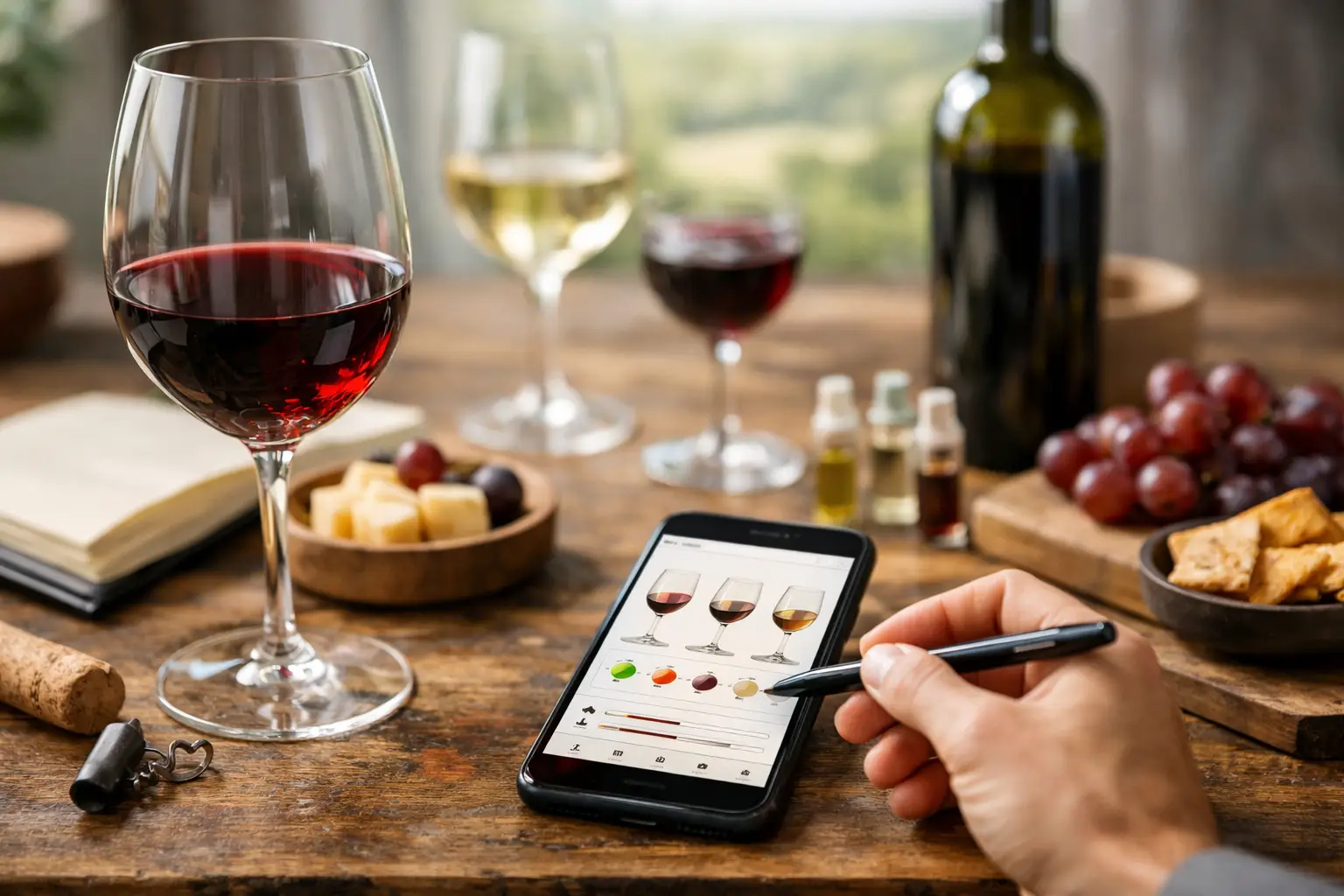
You open a bottle you loved three months ago, pour a glass, and realise you can’t quite remember why it stood out. Was it the soft stone fruit, the crisp finish, or simply that you drank it with the right meal on the right evening? That is exactly where a wine tasting notes app becomes useful - not as a gimmick, but as a practical way to turn vague impressions into a tasting memory you can actually use.
For most people, the problem is not a lack of interest. It is a lack of structure. You know when a wine feels fresh, rich, smooth, sharp or a bit too oaky, yet finding the right words in the moment is harder than it sounds. Then the bottle is gone, the label is binned, and the details disappear with it. A good app closes that gap. It helps you notice more, record it quickly, and return to those impressions later with confidence.
What a wine tasting notes app should actually help you do
The best apps are not really about collecting labels. They are about helping you pay attention. If an app only lets you upload a bottle photo and score it out of five, it may be tidy, but it will not necessarily improve how you taste.
A useful wine tasting notes app should support the full flow of the experience. First, it should help you identify what is in the glass. Next, it should make it easy to record aroma, texture, flavour and finish in plain language. Finally, it should let you come back to those notes later and compare bottles over time.
That last part matters more than many people expect. Wine becomes easier to understand when you can place one bottle next to another in your memory. You start noticing patterns. Perhaps you consistently enjoy higher-acid whites, or perhaps you say you like bold reds but repeatedly save lighter, fresher bottles as favourites. A note-taking system is not just a record. It is feedback.
Why most tasting notes fail
Many people begin with good intentions and then stop after two or three bottles. Usually, the system is either too vague or too demanding.
If it is too vague, every note says roughly the same thing: nice, smooth, fruity, dry. That may be honest, but it is not especially helpful later. If it is too demanding, note-taking starts to feel like homework. Long forms, specialist jargon and rigid scoring systems can make a relaxed evening at home feel oddly formal.
The right balance is simple but guided. You want enough structure to notice key details, without feeling tested. That is especially true for people who are interested in wine but do not want to perform expertise. No wine knowledge needed should not be a slogan. It should be visible in how the app works.
The features that matter most in a wine tasting notes app
Ease matters first. If saving a bottle takes too many steps, you will stop doing it. A strong app should let you add a wine quickly, save your impressions without friction, and return later when you have more time to reflect.
After that, guided language becomes the real differentiator. Many users do not need more information about regions or grapes at the start. They need help answering a simpler question: what am I noticing right now? Prompts around fruit, spice, floral notes, body, acidity, tannin and finish can make tasting feel clearer without becoming stiff.
Search and comparison tools are equally valuable. Once you have logged ten or twenty bottles, your notes should become more useful, not harder to manage. Being able to revisit past entries, group similar wines, and compare favourites across styles turns casual drinking into a more intentional habit.
Some people also benefit from audio guidance rather than text-heavy interfaces. Listening to calm, well-structured prompts while tasting can be more natural than stopping repeatedly to type. It keeps your attention on the glass rather than on the screen, which is often where confidence begins to build.
Better notes lead to better buying decisions
One overlooked benefit of using a wine tasting notes app is that it improves what happens before the cork is pulled. When you know what you have enjoyed in the past, buying wine becomes less random.
Instead of relying on a vague memory of a label you once liked, you can check your notes and see what actually appealed to you. Maybe it was the bright citrus character of a Picpoul, the softer tannins of a Pinot Noir, or the savoury finish of a Rioja with a few years on it. That is much more useful than trying to remember whether the bottle had a cream label or a gold capsule.
This does not mean your choices become narrow. In fact, the opposite often happens. Once you have a clearer sense of your preferences, it is easier to branch out with purpose. You stop buying at random and start exploring with context.
A wine tasting notes app is most useful at home
There is a common assumption that tasting tools are mainly for professionals, trade events or winery visits. In practice, they are often most helpful at home, where there is less pressure and more room to pay attention.
Home tasting is where habits form. It is where you start to recognise that one Chardonnay feels creamy and broad while another feels taut and mineral. It is where food pairing becomes less theoretical. It is where you notice whether a wine changes after twenty minutes in the glass. Those details are easy to miss unless you have a simple way to catch them.
That is why digital guidance works well in this setting. It can bring some of the clarity of a structured tasting without making the moment feel formal. For a great many people, that is the sweet spot - more confidence, better language, and no pretence.
The difference between storing notes and building a tasting memory
Not every note is equally useful. A pile of disconnected entries can become digital clutter just as easily as a pile of paper notebooks.
What matters is whether the app helps you build a personal tasting memory. That means your notes are saved in a way that supports pattern recognition. You can revisit past bottles, compare styles, and understand how your preferences are developing over time.
This is where features such as saved collections, personal vaults and side-by-side comparisons become more than nice extras. They change the role of the app. It stops being a passive record and becomes an active learning tool.
Audio Sommelier approaches this well because it combines guided tasting, note saving and comparison in one calm flow. Rather than expecting users to invent a tasting method for themselves, it offers structured support built for trust, not hype. For people who want first sip confidence and better tasting language, that model makes sense.
Who benefits most from using one
A wine tasting notes app is especially helpful for curious beginners, casual enthusiasts and anyone who tends to forget what they liked. If you often find yourself saying, “I know I’ve had something like this before,” then you are exactly the kind of person who benefits from keeping better notes.
It is also useful for couples or households who share bottles but have different preferences. One person may care more about texture, another about aroma. Recording both reactions can make future choices easier and more enjoyable.
If you already know a fair bit about wine, an app can still be worthwhile, but your needs may be different. You may care more about comparison, cellar-style record keeping or detailed classification. In that case, the best tool depends on whether you want a technical logbook or a more guided tasting companion. It really does depend on how you drink, what you want to remember, and whether learning or cataloguing matters more to you.
Choosing the right wine tasting notes app for you
Start with honesty. If you want something you will genuinely use every week, simplicity matters more than depth. If you want to improve your palate and your vocabulary, guided prompts matter more than large databases. If you want to remember bottles over months and years, retrieval and comparison matter more than flashy design.
There is no single perfect app for everyone. Some people want a private tasting archive. Others want help describing what is in the glass right now. Ideally, you want both. The strongest option is usually the one that fits naturally into your routine and makes you feel more observant, not more self-conscious.
A good glass of wine often deserves more than a passing impression. When your notes are easy to save, easy to revisit and genuinely useful, tasting becomes less about trying to sound knowledgeable and more about learning what you actually enjoy. That small shift can make every future bottle feel a bit more considered.