3 Nov 2026
Digital Tasting Versus Paper Notebook for Wine
Digital tasting versus paper notebook: compare guidance, memory, privacy and practical use to choose the tasting journal that suits you best at home.
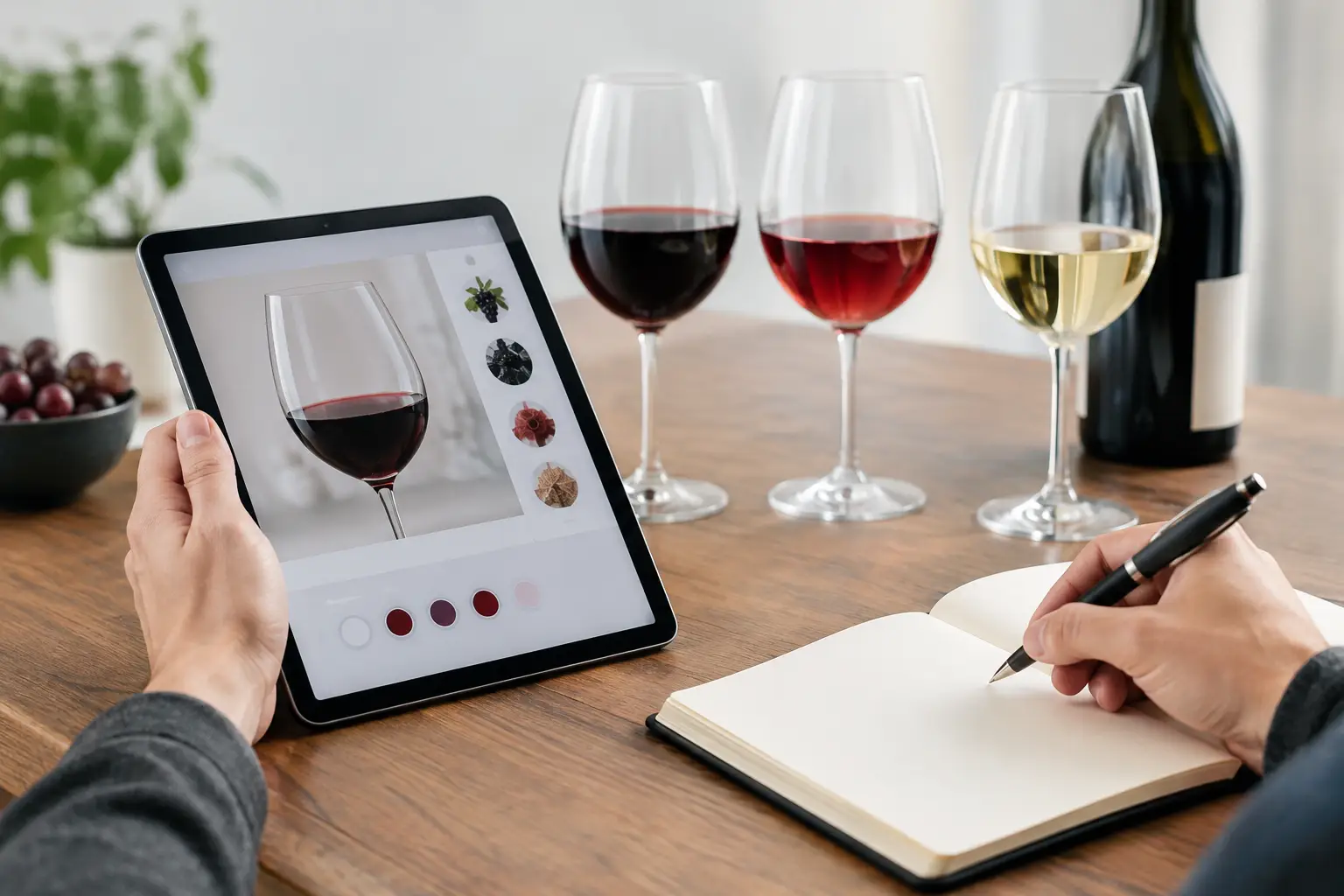
A notebook can capture the moment you opened a bottle. It is less reliable at helping you recognise why you enjoyed it three months later. That is the real question in digital tasting versus paper notebook: not which feels more sophisticated, but which helps you pay attention, find better words and build a tasting memory you will genuinely use.
For many people, the answer is not absolute. Paper brings a pleasing sense of occasion. Digital tools bring guidance and recall. The better choice depends on whether your main aim is to slow down for one glass, learn more confidently over time, or make sense of the bottles already in your cupboard.
What a paper notebook does beautifully
A paper notebook asks very little of you. Open it, write the date, add the bottle name and record what you notice. There are no settings to adjust and no concern that a screen will interrupt a relaxed evening. For a quiet solo tasting, the physical act of writing can make the experience feel more deliberate.
It also leaves room for personality. You might sketch a label, press in a receipt from a special dinner, or write a memory alongside a few notes about blackberry, cedar or toasted hazelnut. Those details can make a notebook feel like a private record rather than a formal tasting log.
Paper can be especially useful when you already know your own structure. If you understand how to move from appearance to aroma, flavour, texture and finish, a blank page offers freedom. Some experienced enthusiasts prefer it precisely because it does not suggest what they should notice.
There is another advantage: it is distraction-free. A notebook does not deliver notifications, tempt you to check messages or turn tasting into a task to complete. If your goal is simply to be present with a favourite bottle, that simplicity has value.
Where handwritten notes can lose their usefulness
The difficulty is rarely writing the first note. It is retrieving the tenth, fiftieth or hundredth note when you are standing in a shop or choosing a bottle for friends. Unless you maintain a very consistent system, entries become hard to search and compare.
A note such as “nice, rich, smooth” may feel sufficient on the night. Later, it tells you very little. Was the richness fruit-driven, sweet, oaky or creamy? Did smooth mean low tannin, soft bubbles, a rounded texture or simply that the drink went down easily? None of these responses is wrong. They just need a little more context to become useful.
Paper also places the full burden of structure on the taster. Beginners often know they like or dislike something but are unsure where to look next. Without a prompt, it is easy to focus on flavour alone and miss acidity, bitterness, weight, warmth, length or the way a drink changes after a few seconds.
That is not a failing of the notebook. It is a reminder that recording and learning are different jobs. A page preserves an observation. It does not necessarily help you form one.
Digital tasting versus paper notebook: guidance is the difference
Digital tasting is most helpful when it acts as a calm companion rather than a scorecard. The strongest experience does not tell you what you ought to smell. It gives you a clear place to begin: take a small sip, notice the first impression, then consider the texture, the balance and the finish.
Audio guidance works particularly well here because your eyes can remain on the glass. Instead of reading a long checklist, you can taste at an unhurried pace and respond to simple sensory prompts. Is the texture crisp or rounded? Does the aroma feel fresh, fruity, floral, savoury, spicy or earthy? Does the finish disappear quickly, or stay with you?
This approach can reduce the intimidation that surrounds tasting language. You do not need to identify an exact variety of orchard fruit or name a particular spice on your first attempt. “Fresh green apple”, “warm baking spice” and “drying on the gums” are useful observations. Better vocabulary grows from repeated attention, not from trying to sound like an expert.
A digital tool can also adapt the structure to the drink in your glass. The cues that matter for a peated whisky are not identical to those that matter for a sparkling wine, a pale ale or a herbal liqueur. A well-designed guide gives enough direction to make the tasting meaningful without making it feel scripted.
A searchable memory changes what you buy next
The practical strength of digital records appears after several tastings. Searchable notes turn scattered impressions into patterns. You may discover that you enjoy bright, mineral white wines more than heavily oaked styles, or that your preferred whiskies share a waxy texture and a gentle smoky finish rather than high strength alone.
That knowledge makes buying easier. Instead of relying on a vague memory of a label, you can return to the elements you enjoyed. It also helps when planning a dinner, choosing a gift or building a small tasting flight for friends. Your past notes become a personal reference point, not a pile of pages waiting to be reread.
Comparing saved bottles is where a digital tasting memory can become genuinely educational. Taste two similar drinks side by side and a difference that seemed abstract suddenly becomes clear. One red may feel more acidic and lifted; another may be softer, darker and more tannic. One gin may lead with citrus, while another feels more savoury and herbal.
Audio Sommelier is designed around this progression: add what you already own, save your impressions, then use guided tastings and comparisons to make those impressions more useful over time. The point is not to replace your palate with technology. It is to give your palate a clearer record and a more confident starting point.
Choose the format that suits your real habit
Choose paper if you enjoy writing by hand, already have a reliable note-taking method and value a screen-free ritual above fast retrieval. A notebook may be all you need if you taste occasionally and mostly want a personal keepsake.
Choose digital if you want prompts while tasting, prefer notes you can find later, or are still learning how to describe aroma, flavour and texture. It is also the stronger option if you taste across several categories. Keeping wine, beer, whisky and spirits in separate notebooks can become cumbersome quickly.
Consider a hybrid approach if the ceremony of paper matters to you. You might write a brief free-form reflection after a special bottle, then save the practical tasting details digitally. This preserves the pleasure of handwriting while ensuring your useful observations remain searchable.
There is no prize for using the most traditional method. The best system is the one you return to when the bottle is empty and the memory is still fresh.
Trust, privacy and ownership matter too
A digital record should feel as private as a notebook on your shelf. Before committing to any tasting platform, consider what is stored, whether you can access your own notes easily, and whether the service is clear about billing and account controls. A thoughtful digital experience should earn trust through clarity, not hype.
Paper has a different privacy profile. It is not collected by a service, but it can be lost, damaged or left where others can read it. Neither format is automatically more secure in every circumstance. The sensible choice is the one whose trade-offs you understand and feel comfortable with.
It is also worth resisting the urge to turn tasting into constant scoring. A number out of ten can be helpful for quick sorting, but it rarely captures why a drink suited a particular evening. Leave room for context: who you were with, what you ate, how the drink changed in the glass, and whether you would choose it again.
Make every note earn its place
Whichever method you choose, keep your first entries simple. Record the bottle, date and setting, then note one aroma, one flavour, something about texture and a thought about the finish. Add what you would change next time, such as serving it cooler, pairing it with food or comparing it with another saved bottle.
Over time, those small observations become more valuable than a page full of borrowed descriptors. Tasting is not a test of what you can name. It is a practice of noticing what is in front of you, remembering it clearly, and returning to your next glass with a little more confidence.