26 Jun 2026
How to Build Tasting Vocabulary at Home
Learn how to build tasting vocabulary at home with simple, practical steps that help you describe aroma, texture, flavour and finish.
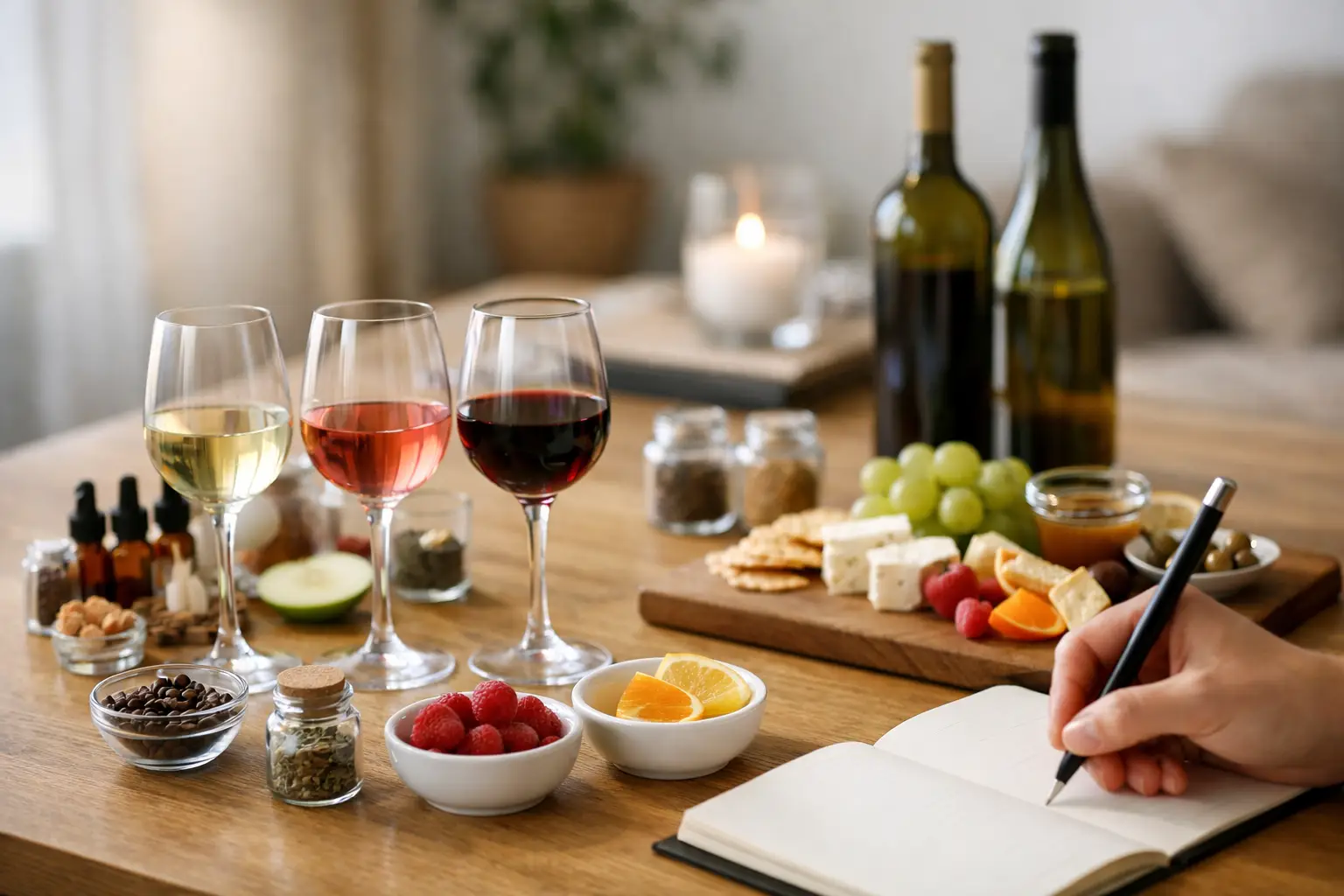
You know the feeling: you take a sip, recognise that you like it, then stall when it comes to describing why. Not because your palate is poor, but because tasting language is a skill. If you want to learn how to build tasting vocabulary, the goal is not to sound clever. It is to notice more clearly, describe more honestly, and remember what you actually enjoyed.
That shift matters whether you drink wine on a Friday night, compare whiskies with friends, or want to choose beer and spirits with more confidence. Better language does not make tasting more formal. It makes it more useful.
Why tasting vocabulary feels harder than it should
Most people are not short on senses. They are short on structure. Aroma, flavour, texture and finish happen quickly, often all at once, and without a framework the mind grabs for vague words like nice, smooth, strong, fruity or harsh.
Those words are not wrong. They are simply too broad to help you learn. If every white wine is crisp and every red is rich, you do not build memory. You repeat labels without adding detail.
There is also a confidence problem. Tasting culture can make people feel that there is one correct answer hidden in the glass. There rarely is. Two people can taste the same bottle and notice different things, especially if one is more sensitive to bitterness, oak, smoke or acidity. Good vocabulary is not about performing expertise. It is about naming your own experience with more precision.
How to build tasting vocabulary without overcomplicating it
The fastest way to improve is to stop trying to identify everything at once. Work in four lanes: aroma, taste, texture and finish. This gives your brain a simple path to follow every time you pour a glass.
Start with what the aroma reminds you of
Do not begin with technical categories. Begin with memory. Does it smell like apple skin, lemon peel, vanilla yoghurt, black tea, fresh herbs, toasted nuts, dark chocolate or damp earth after rain? Familiar references are easier to retrieve than abstract tasting terms.
Specificity matters more than sophistication. Berry is less useful than raspberry. Spice is less useful than clove or cracked black pepper. Wood is less useful than cedar, pencil shavings or toasted oak. You are building a library, and vague labels do not give you much to shelve.
If you struggle at first, compare what is in the glass with things in your kitchen. Smell citrus zest, a jar of honey, ground coffee, a cinnamon stick, sliced pear, fresh mint. This kind of practice trains recall. Over time, the leap from real-world smell to tasting note becomes much shorter.
Then separate flavour from texture
People often confuse the two. Flavour is what something tastes of. Texture is how it feels in the mouth.
A whisky might taste of dried fruit and toffee, while feeling oily and warming. A sparkling wine might taste of green apple and brioche, while feeling sharp, fine-bubbled and light. A stout might show coffee and cocoa flavours, but the texture could be creamy, dense or softly foamy.
When you split those ideas apart, your notes become clearer very quickly. Smooth, for example, is often doing too much work. Do you mean low in bitterness, soft in texture, rounded in alcohol, or easy to drink? Each says something more useful.
Give the finish its own moment
The finish is where a lot of tasting memory is formed, yet many people ignore it. After swallowing, ask what stays behind. Is the flavour short or lingering? Does it end cleanly, dry out the palate, turn bitter, become sweeter, or reveal a new note such as pepper, smoke or citrus pith?
This is especially helpful when comparing similar drinks. Two gins may open with similar juniper and citrus character, but one may finish floral and bright while the other ends earthy and spicy. That final impression often explains preference better than the first sip.
Build a vocabulary you will actually use
A useful tasting vocabulary is personal before it is professional. If a note means nothing to you, it will not stick.
Use your own references first
If rhubarb crumble, Earl Grey, digestive biscuits or blackcurrant squash are common points of reference in your life, use them. They are valid. Tasting language is most powerful when it connects to memory you can access instantly.
This is one reason guided tasting can help beginners so much. Calm prompts reduce the pressure to invent the perfect word and instead help you recognise what is already there. No wine knowledge needed, just attention.
Group words into simple families
You do not need a giant lexicon. Start with a few sensory families and build from there: fruit, citrus, floral, herbal, spice, nutty, toasted, dairy, earthy, smoky, sweet and savoury. Within each family, collect a few specifics you notice often.
For example, under fruit you might keep apple, pear, peach, plum, blackberry and dried fig. Under spice, perhaps black pepper, cinnamon, clove and ginger. This keeps your language organised without making tasting feel like revision.
Keep “intensity” words close by
Descriptive words become stronger when paired with scale. Try light, bright, ripe, fresh, cooked, concentrated, subtle, lifted, round, lean, firm or drying. They help describe not just what you notice, but how it appears.
A beer is not only citrusy. It may be bright citrusy or peel-like citrusy. A red wine is not only fruity. It may be ripe black fruit or tart red fruit. Those small adjustments make your notes much more accurate.
How to build tasting vocabulary through repetition
One good tasting note is helpful. Ten notes on ten different bottles are less useful than five notes made in a consistent way. Pattern recognition needs repetition.
The easiest method is to taste similar things side by side over time. Compare two Sauvignon Blancs from different regions, two bourbons with different proof levels, or two lagers with distinct hop profiles. Similar categories make contrast easier to detect.
When you compare, ask the same questions each time. What do I smell first? What changes after a few seconds? What is the texture like? What stays on the finish? A repeatable sequence turns tasting from guesswork into practice.
Saving your notes matters too. Memory is less reliable than people think. What feels obvious in the moment becomes fuzzy a week later. A simple record of what you tasted, what you noticed and whether you enjoyed it gives your vocabulary somewhere to live. It also helps you see your own patterns, which is often more useful than learning generic tasting terms.
Common mistakes when building tasting language
One mistake is chasing rare or dramatic notes too early. If you are always hunting truffle, saddle leather or struck flint, you may miss the obvious and important signals in front of you. Start with the clearest impression, then refine.
Another is copying someone else’s note without checking whether it matches your own experience. Professional descriptors can be helpful, but they are not a script. If a tasting note says apricot and you get peach, that is not failure. It may simply be the closest reference your memory provides.
A third mistake is writing too much. Long notes can hide weak observation. A few accurate words are better than a paragraph of padded language. Apple, lemon peel, chalky texture, dry finish tells you more than a cloud of grand but empty adjectives.
A simple tasting routine you can return to
If you want a dependable way to practise how to build tasting vocabulary, keep the routine short. Pour a small glass. Smell before you sip. Name two aroma references. Take a sip and identify one flavour, one texture word and one finish word. Then decide whether you would want another glass and why.
That final question matters because preference is part of learning. Tasting is not only analysis. It is judgment, enjoyment and memory working together.
With time, your vocabulary will widen naturally. You will move from fruity to baked apple, from smooth to silky, from strong to warming with a peppery finish. That is real progress: not sounding more impressive, but understanding your own palate with more clarity.
If you want support, a guided platform such as Audio Sommelier can make that practice feel less intimidating by turning each bottle into a structured, repeatable tasting session you can actually learn from.
The best tasting language is the language that helps you notice more, choose better, and return to the bottles you loved for reasons you can finally put into words.