28 Sep 2026
Audio Tasting Versus Wine Course: Which Fits?
Audio tasting versus wine course: compare flexible guided sessions with structured study, and choose a better way to build confidence at home today, calmly.
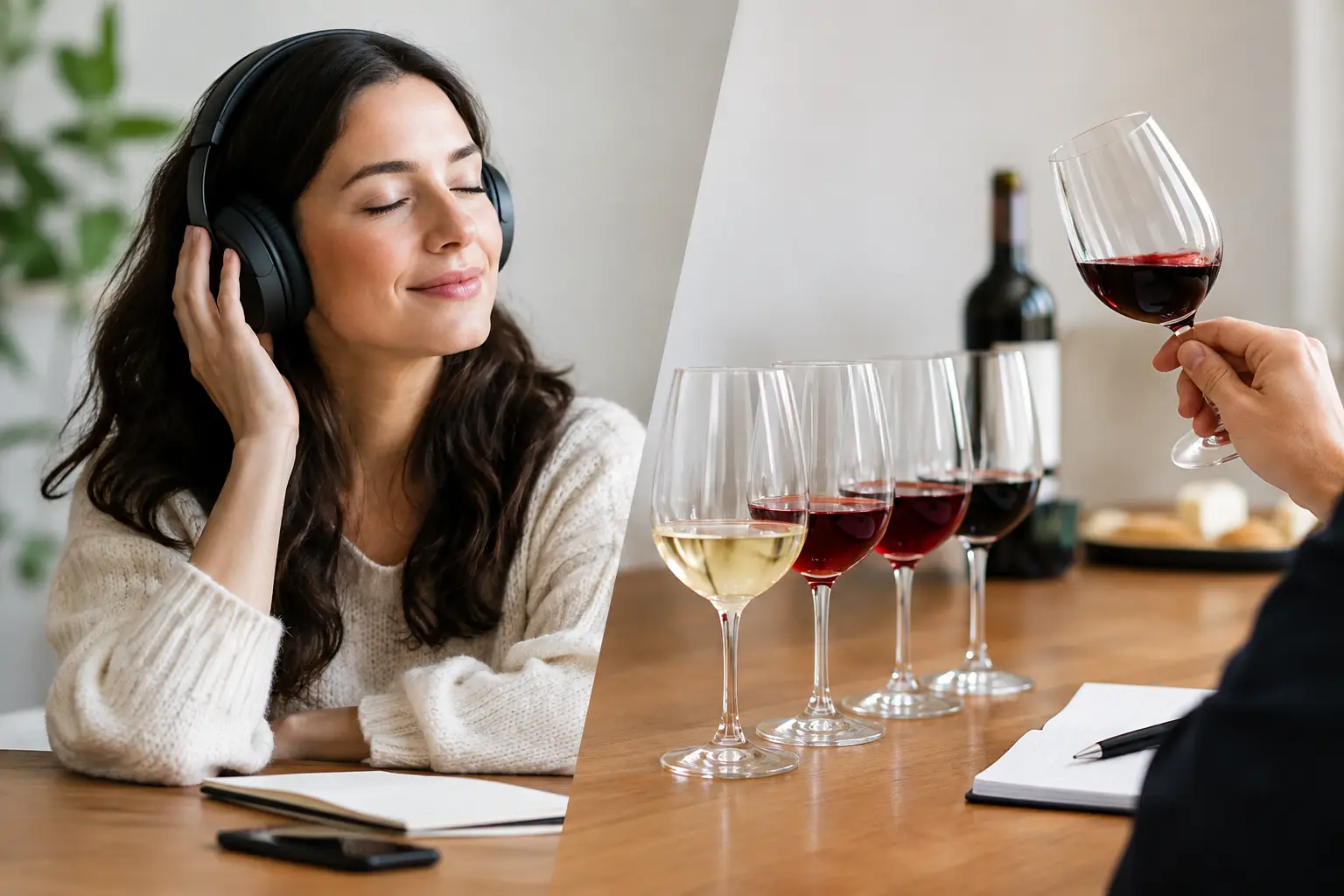
A bottle can feel surprisingly quiet once it is open. You may know that you like it, yet struggle to say why: is that freshness citrus, green apple or simply acidity? This is where audio tasting versus wine course becomes a useful comparison. Both can improve your palate, but they serve different moments, goals and budgets.
A wine course gives you a planned route through regions, grapes, styles and service. Audio-led tasting gives you a calm companion for the glass already on your table. Neither is automatically better. The right choice depends on whether you want a recognised framework, practical confidence at home, or a little of both.
Audio tasting versus wine course: the essential difference
The clearest distinction is structure. A wine course usually follows a fixed syllabus. You learn in a group or through set study materials, often progressing from foundational topics to more detailed questions of geography, production and classification. There may be an examination at the end. That structure is valuable when you want a broad base of knowledge or a qualification that demonstrates it.
Audio tasting begins with a different question: what are you noticing in this glass, right now? A guided session can prompt you to look at colour, take a considered first smell, notice fruit, spice, oak or floral notes, and pay attention to weight, texture and finish. The learning is still structured, but it is organised around your own bottle and your own pace.
For many people, the gap is not a lack of facts. It is the moment between taking a sip and finding words for it. Audio guidance helps bridge that gap without asking you to memorise a map of every wine region before you can enjoy a Saturday evening glass.
What a wine course does particularly well
A good wine course is more than a tasting event. It gives context that is hard to gather casually: how climate shapes ripeness, why one grape can taste different across countries, how winemaking choices influence texture, and what labels are trying to tell you. If you work in hospitality, retail or distribution, formal study can be especially useful. A certificate may also matter when applying for roles or building professional credibility.
The discipline can be motivating too. A timetable creates momentum. You may taste wines side by side that you would not otherwise choose, receive feedback from an educator and meet other learners with the same interest. For someone who enjoys academic learning, this is part of the pleasure.
There are trade-offs. Courses ask for time, concentration and usually a larger upfront spend. Their pace may be faster or more theoretical than a casual enthusiast needs. You may also taste wines selected for a lesson rather than bottles that fit your own preferences, budget or local availability.
That does not make formal education intimidating by nature. It simply means it is designed for a particular purpose. If your aim is to understand appellation rules or prepare for an exam, a wine course is likely the stronger fit.
Where audio-led tasting feels more useful
Audio-led tasting is designed for repetition in real life. You can use it after a supermarket discovery, during a quiet meal, or while opening something special with friends. There is no need to wait for the next class date, buy a pre-selected case or worry that you have arrived without the right vocabulary.
The spoken format matters. Reading a tasting grid while holding a glass can turn an enjoyable ritual into homework. A measured voice leaves your hands free and gives you permission to pause. You can smell again, take a smaller sip, or sit with the finish before moving on. This tends to make sensory learning feel less like performance and more like attention.
It is also well suited to building personal memory. You might learn that you consistently enjoy a saline, mineral finish in white wine, or that a soft, rounded whisky appeals more than a heavily smoky one. Those patterns are more useful than a generic score because they help you choose your next bottle with greater confidence.
Audio Sommelier takes this practical approach across wine, whisky, beer, spirits, liqueurs and sparkling wine. Its guided sessions are built around bottles you already own, with a private place to save notes and build comparisons over time. No wine knowledge is needed to start.
The learning experience is different, not lighter
It can be tempting to treat a flexible format as less serious. In practice, regular sensory attention is how many tasting skills develop. Your ability to identify aroma, separate sweetness from fruitiness, or recognise tannin improves through repeated encounters with real drinks. A single class may introduce the language, but your palate learns when you return to it.
Audio guidance is particularly helpful for beginners because it can break tasting into manageable actions. First, observe without trying to be impressive. Then smell twice, because the second smell often reveals more. Take a small sip and notice whether the drink feels light, creamy, drying, warming or lively. Finally, ask what stays after you swallow.
These prompts do not tell you what you must find. They give you a way to explore. If you notice pear where someone else notices melon, that is not failure. Sensory language is most helpful when it is honest and specific enough to guide your own future choices.
A wine course may use a more formal tasting framework, which is excellent when consistency and assessment are required. Audio-led sessions can use the same core disciplines in a more personal setting. The difference is less about standards than about pressure and purpose.
Choose based on the outcome you want
Choose a wine course if you want recognised study, professional development, an intensive overview of wine, or the motivation of a fixed programme. It is also a good choice if you enjoy learning through textbooks, tastings led by an educator and discussion with a class.
Choose audio tasting if you want to enjoy what you already buy with more awareness, develop better tasting language gradually, or make evenings at home feel more considered. It is often the easier route for people who are curious but not ready to commit to an exam-focused course.
Your budget and schedule matter as well. A course may involve tuition, travel, study time and tasting samples. A subscription-based audio service spreads the cost and can be used when it suits you, though it will not provide a formal qualification. Be clear about that distinction before you decide.
There is also room for a combined approach. Start with guided tastings to make your senses more confident and your preferences clearer. If your interest grows towards wine history, trade knowledge or certification, a course will feel more rewarding because the basics are already familiar in your glass.
If you are buying a gift
Think about the recipient's habits rather than their perceived expertise. A person who loves hosting, trying new bottles and talking about food may appreciate immediate, repeatable guidance. Someone planning a career change into wine or who enjoys structured study may value a course more.
Avoid assuming that a beginner needs the simplest option. Many beginners are eager to learn; they simply need an inviting first step. Equally, an experienced drinker may not want another certificate. They may want a better way to remember the exceptional bottle they opened last month.
A better first tasting at home
Whichever route you choose, begin with a bottle you are genuinely pleased to open. Pour a modest measure into a clean glass and give yourself ten unhurried minutes. Notice the appearance, then the aroma before you taste. On the palate, pay attention to balance: does acidity make your mouth water, does tannin gently dry it, does alcohol bring warmth, and how long does the flavour remain?
Write down only what feels useful. A few words such as “bright lemon, chalky, crisp finish” are enough. Add where you drank it, what you ate and whether you would buy it again. Over several bottles, those small notes become a reliable record of your taste rather than a test you have to pass.
The best learning path is the one that makes you want to pour a thoughtful next glass. Let curiosity set the pace, and let each bottle give you one new thing to notice.