28 Oct 2026
AI Flavour Coach Versus Sommelier: Which Helps?
AI flavour coach versus sommelier: see how each helps you taste wine and spirits with more confidence, clearer language and a stronger memory over time.
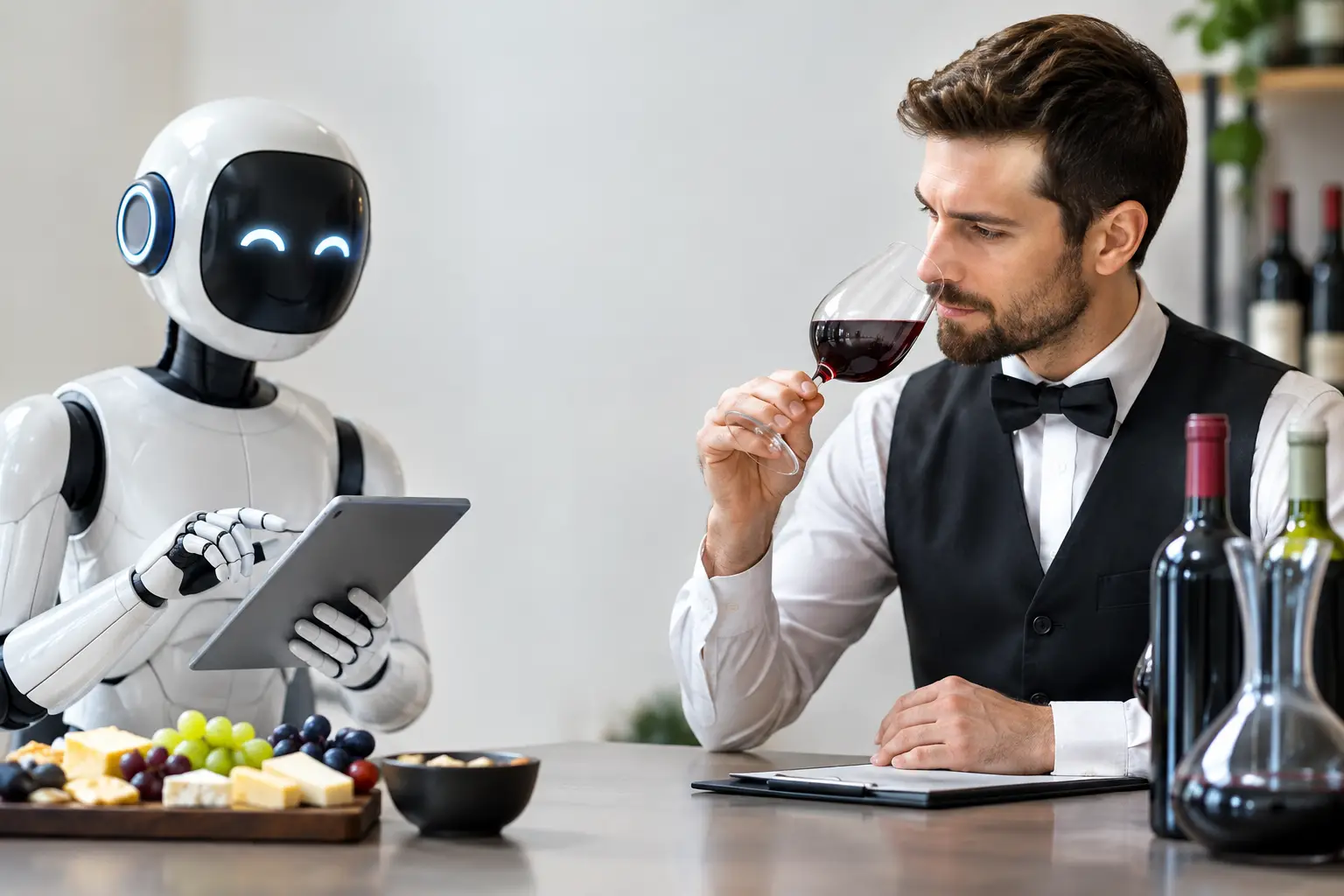
A bottle can be perfectly good and still feel disappointing when you do not know what to look for. Perhaps you can tell that a red is rich, or that a whisky feels warming, but turning that first impression into useful tasting language is another matter. The question of an AI flavour coach versus sommelier is therefore not really about replacing expertise. It is about deciding what kind of guidance helps you enjoy the bottle in front of you.
A human sommelier can bring lived experience, hospitality and judgement to a particular occasion. An AI flavour coach can offer private, repeatable guidance whenever you are at home with a glass and a little curiosity. Both can make tasting more rewarding. Their strengths simply sit in different places.
What a sommelier brings to the table
A sommelier is more than someone who can identify a grape variety or recommend an expensive bottle. In a good restaurant, wine bar or specialist shop, they read the moment as well as the glass. They may notice what you have ordered, ask about your preferences, account for the budget and suggest a pairing that makes sense for the meal.
That human judgement is particularly valuable when the choice is open-ended. If you are planning a dinner for six, choosing a bottle as a gift, or working through a wine list you have never seen before, an experienced sommelier can narrow the options quickly. The best ones also make the conversation feel welcoming rather than performative.
Their knowledge can be wonderfully specific. A sommelier may explain why a particular producer, vintage or serving temperature matters, or recognise a fault in a bottle that does not taste as it should. They can respond to subtle social cues too. If you say you dislike heavily oaked Chardonnay, a thoughtful professional will know whether you mean the flavour itself, the texture, or a past bad experience.
There are limits, however. A sommelier is not usually beside you for every midweek pour. Their advice may happen in a busy setting, where there is little time to pause, smell again and develop your own words. And although great hospitality should never intimidate, some people feel self-conscious asking basic questions face to face.
What an AI flavour coach does differently
An AI flavour coach is designed for the more regular, personal part of tasting. Rather than choosing what you should buy, it can help you understand what you already own. It guides attention through aroma, appearance, texture, flavour and finish, giving each stage enough space to become noticeable.
That structure matters. Many beginners assume tasting notes are a test with right and wrong answers. They are not. If a whisky reminds you of baked apple, toasted nuts or damp woodland after rain, that is a useful starting point. The purpose of guided tasting is to help you notice patterns, not to pressure you into naming every aroma on a professional flavour wheel.
With an AI coach, you can ask questions at the moment they occur. Is the drying sensation tannin? Why does this sparkling wine feel creamy? What is the difference between peppery and spicy? The answer can be tailored to the drink category and expressed in plain language, without making you feel as though you should already know the terminology.
It is also consistent. A guided audio tasting does not rush because the venue is closing or because someone else needs attention. You can revisit a favourite bottle months later, compare it with another saved drink and see whether your preferences have changed. That ongoing record is difficult to build from occasional conversations, however valuable those conversations may be.
AI flavour coach versus sommelier: the practical difference
The most useful comparison is not human versus machine. It is occasion versus habit.
A sommelier excels when you need informed recommendation, food pairing, bottle selection or a personal interaction in a hospitality setting. Their experience can turn a meal into an occasion, especially when you are exploring an unfamiliar list or region.
An AI flavour coach excels when you want to build your own palate at home. It is available for the bottle you picked up after work, the beer you brought back from holiday, or the liqueur at the back of the cupboard that you have never quite understood. You can move at your own pace and return to the guidance as often as you like.
The trade-off is clear. AI can offer an organised learning process and immediate explanations, but it cannot smell your exact glass or physically inspect a corked bottle. A human professional can use their senses and real-world context in ways software cannot. Equally, a sommelier cannot automatically retain every taste you have had across your home collection unless you keep your own detailed notes.
For many people, the best approach is both. Ask a sommelier for a memorable recommendation when dining out or buying something special. Then use guided tasting at home to understand why you liked it and whether the same characteristics appear in other bottles.
Why guided tasting helps beginners progress
The value of a flavour coach is not that it supplies more descriptors. It helps you create a reliable sequence of attention. Start with what you see, then take time with the aroma. Notice how the drink sits in the mouth: light or full, soft or sharp, silky or drying. Finally, consider what remains after you swallow.
Once that sequence becomes familiar, tasting feels less mysterious. You may begin to notice that you often enjoy citrus-led whites with a crisp finish, or whiskies with orchard fruit and gentle spice rather than heavy smoke. Those observations are more useful than trying to memorise facts about every region.
A personal tasting memory adds another layer. Memory is unreliable after a few weeks, particularly when several bottles begin to blur together. Saving a short note such as “bright lemon, saline edge, better with food” gives your future self something real to work with. Over time, comparisons become easier and buying decisions become more confident.
This is where Audio Sommelier is intended to be practical rather than ceremonial: add a bottle, save it, and start a guided audio tasting. The aim is not to make every drink formal. It is to make the moments when you want to pay attention feel clear, calm and worthwhile.
Can AI make tasting less personal?
Only if it is used as a script rather than a companion. Good tasting guidance should leave room for your own associations, cultural references and preferences. One person might find vanilla in a bourbon; another may think of custard, coconut or an old-fashioned sweet shop. Those impressions can all point towards similar flavour families without needing to be identical.
The same principle applies to recommendations. An AI tool may help you describe what you enjoy, identify styles to explore and compare notes from your own collection. It should not pretend that preference can be calculated perfectly. Mood, food, company and setting all influence how a drink tastes.
Trust also matters. For legal-age adults, an alcohol-focused digital service should be transparent about what it is and is not. It can educate, organise and guide sensory attention. It should not encourage excessive consumption, claim certainty where there is none, or turn tasting into a scorecard. Better tasting is often about slowing down, not drinking more.
Choose the guide that fits the moment
If you are sitting opposite a knowledgeable professional with a thoughtful wine list, ask the question. Their answer may introduce you to a bottle you would never have selected alone. If you are at home with a glass you would like to understand better, an AI flavour coach can give you the confidence to begin without waiting for an expert to be present.
The most satisfying outcome is not sounding like a sommelier. It is recognising what you enjoy, being able to explain it simply, and remembering enough to choose your next bottle with a little more certainty.