7 Jun 2026
How a Whisky Tasting Notes App Helps
A whisky tasting notes app helps you remember bottles, build tasting language, and compare drams with more confidence at home over time.
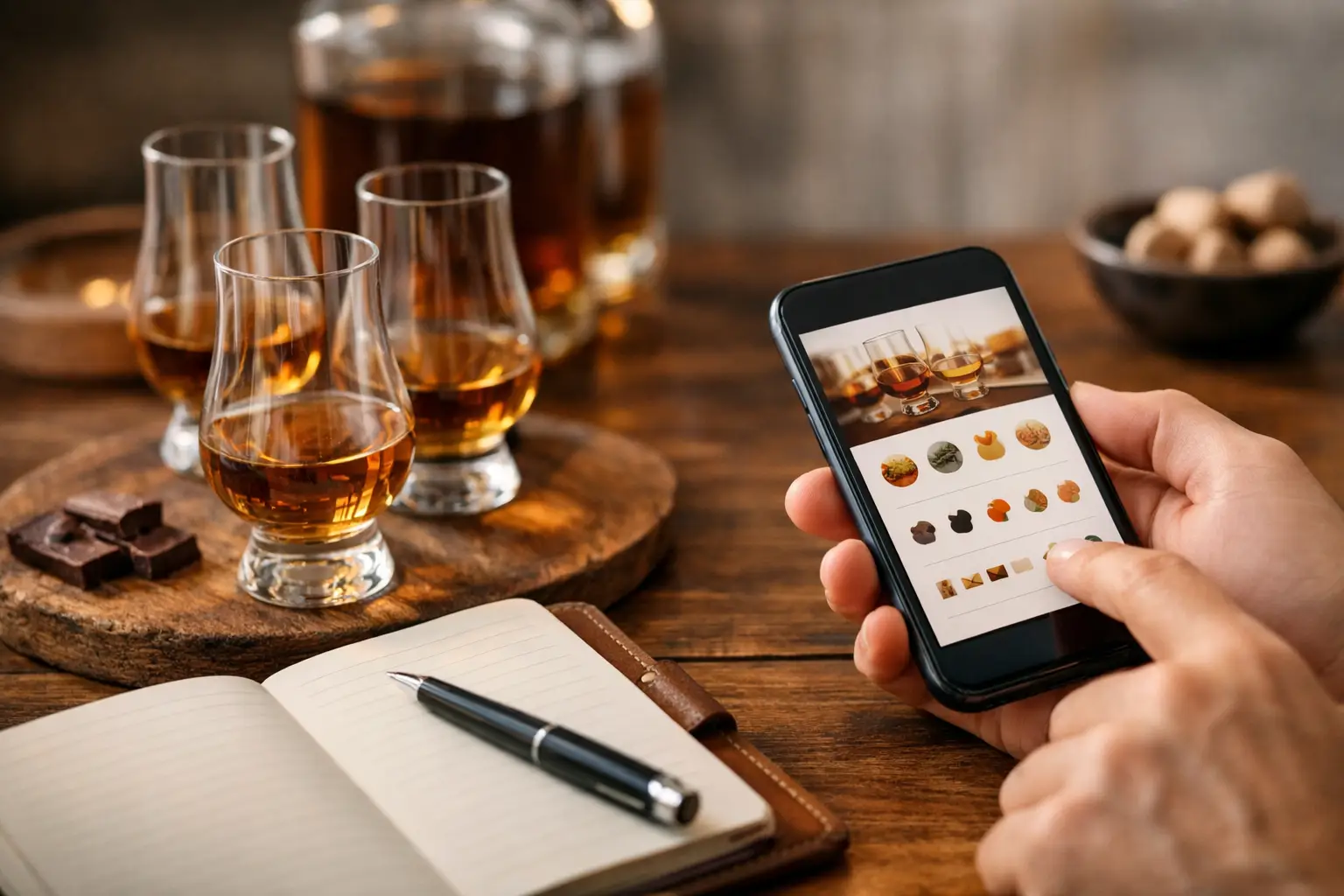
Most people do not struggle to enjoy whisky. They struggle to remember it. A bottle tastes rich and layered on Friday night, then somehow becomes hard to describe by Sunday. That is where a whisky tasting notes app starts to earn its place - not as a novelty, but as a practical tool for turning a fleeting impression into something you can revisit and trust.
For anyone trying to taste more intentionally at home, memory is usually the first weak point. You might recall that one bottle felt smoky, another softer and sweeter, and a third had a finish you really liked, but the details blur quickly. Without a simple way to capture what you noticed, every new pour risks becoming another vague favourite. An app gives structure to that moment while the glass is still in front of you.
Why a whisky tasting notes app is useful
The value is not only in saving notes. It is in giving shape to your attention. When you know you are going to record aroma, palate, texture and finish, you naturally slow down. You stop asking, “Do I like this?” and start asking, “What exactly am I noticing?” That small shift is often the difference between casual drinking and real tasting.
This matters even more for beginners and developing enthusiasts. Whisky language can feel oddly public. If you are tasting with friends, at a bar, or even just reading a bottle review online, it can seem as if everyone else has a complete vocabulary ready to go. Most do not. They have simply practised noticing patterns. A good app helps you practise privately, at your own pace, with enough structure to build confidence rather than second-guess yourself.
There is also a practical benefit. If you buy whisky with any regularity, you are already curating preferences whether you mean to or not. Maybe you lean towards orchard fruit and vanilla in Speyside malts, or perhaps you keep returning to coastal salinity and peat. Without records, those patterns remain fuzzy. With notes saved over months, they become visible. That makes future buying easier, more personal and often more economical.
What to look for in a whisky tasting notes app
Not every app solves the same problem. Some work like a digital notebook. Others focus on bottle catalogues, barcode scans, ratings or social sharing. Those features can be useful, but they are not always the ones that actually help you taste better.
The strongest starting point is guided structure. If the app prompts you through nose, palate, mouthfeel and finish, it reduces the intimidation factor immediately. You do not need to invent a method every time you pour. That is especially helpful if you enjoy whisky but would not call yourself an expert.
Clarity matters as much as depth. An app filled with specialist terminology may look impressive, but if it leaves you unsure what to write, it has missed the point. Better tools use accessible language and calm prompts. Instead of pushing you towards performative tasting notes, they help you describe what is genuinely in the glass for you.
Storage and retrieval are just as important. Notes are only useful if you can find them later. If you cannot compare one bottle with another, sort by style, or revisit your saved drams before buying again, the app becomes an archive rather than a memory system. The best experience is one that helps you add, save and return with very little friction.
The difference between rating whisky and understanding it
A lot of people start by scoring bottles out of ten or out of one hundred. There is nothing wrong with that, but ratings alone are thin. A score tells you whether you enjoyed something in a broad sense. It does not tell you why.
That is where tasting notes become more useful than rankings. If you record that a whisky opened with dried fruit, moved into baking spice, felt oily on the palate and finished slightly bitter, you have something practical. You can compare it with another bottle that seemed brighter, creamier or more floral. Over time, your own language becomes more consistent. You are no longer relying on a number detached from context.
This is also where guided digital tasting has an advantage. Many people know what they are sensing but not how to phrase it. A prompt such as “What do you notice first on the nose?” is easier to answer than a blank text box asking for a review. Structured support lowers the barrier. It helps you move from “nice and smoky” towards more useful observations without making the process feel formal.
A whisky tasting notes app works best when it teaches you as you go
The most helpful tools do not just collect your thoughts. They quietly improve them. That can happen through smart prompts, suggested tasting categories, or audio guidance that walks you through the glass in real time.
This matters because tasting is a skill built through repetition. You do not need to memorise hundreds of aroma descriptors before you begin. You need a process you will actually return to. If the app makes the experience feel calm and intuitive, you are more likely to use it often enough for progress to happen.
For many drinkers, audio-led tasting is particularly effective. It keeps your attention on the glass instead of on a screen full of options. You can listen, smell, sip and pause without feeling as though you are filling in a spreadsheet. That format suits whisky well because texture, development and finish often reveal themselves slowly. A steady voice can guide that pace better than static text alone.
This is one reason a platform such as Audio Sommelier can feel more useful than a simple notes app. It combines guided tasting, saved records and comparison tools in a way that helps build both confidence and memory. For people who want more from the bottles they already own, that balance of education and practicality makes a real difference.
Where apps can fall short
There are trade-offs. If you want a large public review database, a private tasting-focused app may feel less social. If your main aim is to track collection value or bottle prices, educational guidance may not be the feature you care about most. It depends on whether you see whisky primarily as something to collect, rate, discuss or learn from.
There is also the question of effort. Any note-taking system only works if you use it consistently. If the process feels too long, too technical or too fiddly after the first sip, many people stop. That is why simplicity matters so much. The right app should support the ritual, not interrupt it.
Another common issue is overcomplication. Some users start chasing perfect descriptors and end up less connected to the whisky itself. The goal is not to produce dramatic tasting prose. It is to become more observant and more certain of your own preferences. A useful app keeps that in view.
Building a personal whisky memory at home
The real benefit of using a whisky tasting notes app appears after a few weeks, not a few minutes. Once you have saved several bottles, you can begin to compare them in a grounded way. One peated malt may show more medicinal character than another. A bourbon-cask whisky may feel easier and rounder than a sherry-led dram you admired but did not love. Those distinctions are hard to hold in your head alone.
This becomes especially valuable when entertaining. If friends come round and you want to choose between two or three bottles, your past notes help you serve with more confidence. The same applies when buying a gift or selecting your next bottle online or in a shop. You are no longer guessing based on label design or half-remembered impressions.
More broadly, keeping notes makes home tasting feel more intentional. It creates a small ritual around attention. You pour less mindlessly. You notice more. And because your impressions are saved, each glass contributes to a growing record of your own palate rather than disappearing into the week.
A whisky tasting notes app is not about making drinking feel like homework. It is about giving your senses somewhere to put what they have learned. If that sounds simple, that is because it should be. The best tasting tools are built for trust, not hype, and they leave you with something genuinely useful after the glass is empty: a clearer sense of what you enjoy, and why.