2 Jul 2026
What Is a Tasting Flight?
What is a tasting flight? Learn how flights work, why they sharpen your palate, and how to build one at home with more confidence.
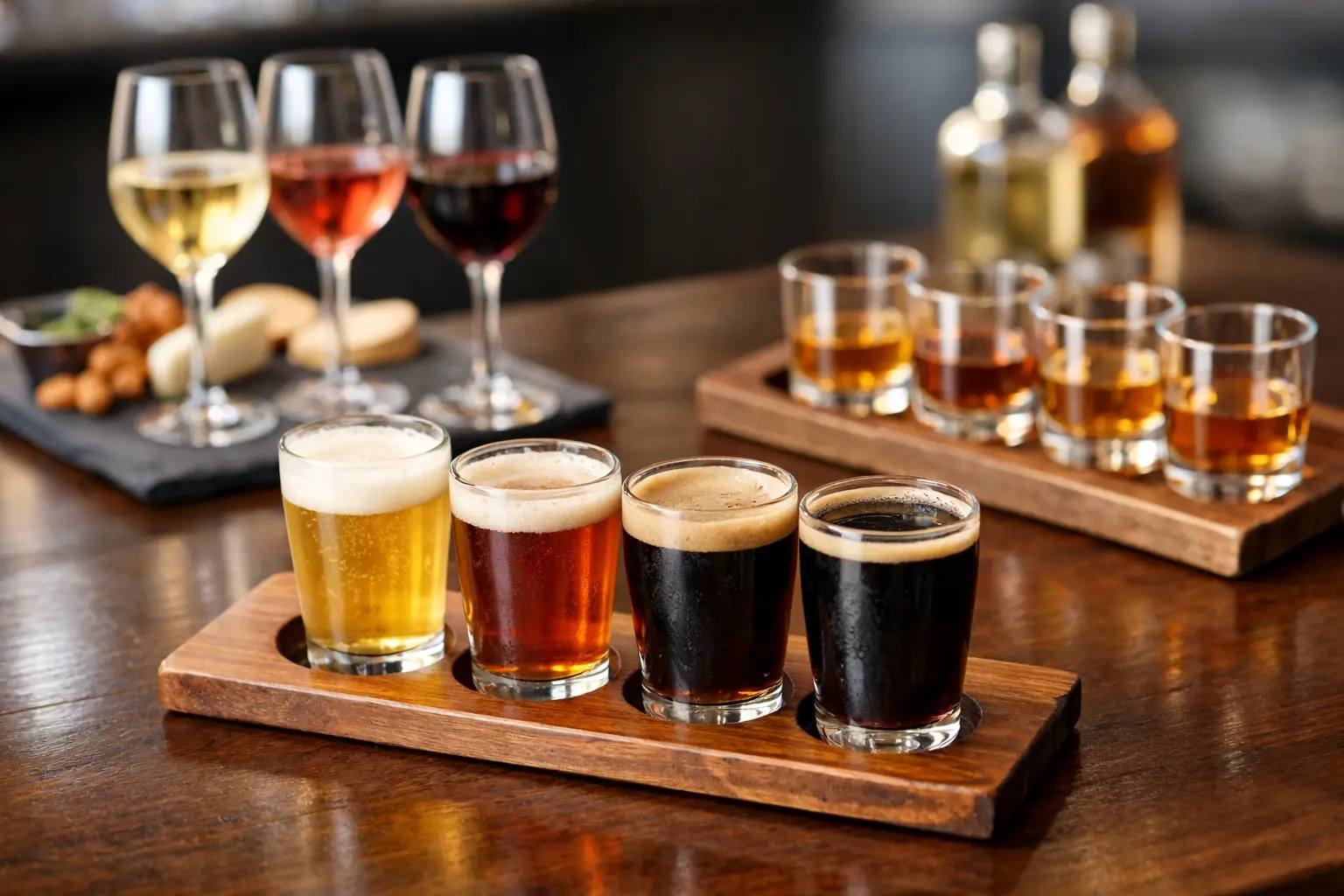
You pour three glasses instead of one, line them up, and suddenly the drink in front of you becomes easier to understand. That is the simplest answer to what is a tasting flight: a small, structured set of drinks served together so you can compare them side by side. Rather than asking you to judge one bottle in isolation, a flight helps you notice contrast - more fruit here, more spice there, lighter body in one, longer finish in another.
For most people, that comparison is where tasting starts to feel less mysterious. You do not need expert vocabulary or a trained palate to notice difference. You only need a clear order, a little attention, and a reason to compare one glass with the next.
What is a tasting flight in practical terms?
A tasting flight is a curated group of small pours, usually linked by a theme. The theme might be grape variety, region, cask type, brewery style, age, production method, or even simply light to rich. Flights are common with wine, whisky, beer, rum, gin, tequila, and sparkling wine, but the principle stays the same: taste similar drinks in a deliberate sequence so their differences become easier to spot.
The pours are smaller than a normal serving because the point is evaluation, not volume. In a wine bar, that may mean three to five small glasses. At home, it could be as simple as two whiskies poured into tasting glasses or three beers shared between friends. A flight does not have to look formal to be useful.
What matters most is structure. Randomly opening several bottles is not quite the same thing. A proper flight has a reason behind it, even if the reason is basic. You might compare two Sauvignon Blancs from different countries, or taste a bourbon next to a rye to understand how grain changes flavour. That intention gives the experience shape.
Why tasting flights work so well
Most people find it hard to describe a single drink on its own. If you sip one glass of red wine, you may know whether you like it, but struggle to explain why. Place it next to another red and your palate gets context. One now seems brighter, softer, more herbal, more tannic, or less sweet than the other.
That is why flights are so effective for beginners and developing enthusiasts. They reduce guesswork. Instead of trying to pull tasting notes out of thin air, you react to contrast. Your senses become more reliable when they have something to measure against.
Flights also build memory more effectively than one-off tastings. When you compare drinks in a sequence, patterns start to stick. You remember that one Chardonnay felt creamy while the other felt taut and citrus-led. You remember that an unpeated whisky carried orchard fruit, while the peated one moved into smoke and medicinal notes. Over time, these comparisons give you a personal reference library.
What makes a good tasting flight?
A good flight is coherent without being repetitive. If the drinks are too similar, the comparison can feel flat. If they are too far apart, the tasting can become confusing. The sweet spot is enough similarity to create a theme, with enough variation to make the differences meaningful.
For wine, a good starting point might be three Pinot Noirs from different regions. For beer, it could be a pale ale, an IPA, and a double IPA. For whisky, you might compare ex-bourbon maturation, sherry cask influence, and peat level. The ideal number is usually three or four pours. Beyond that, palate fatigue can set in, especially if the drinks are high in alcohol or strong in flavour.
Serving order matters as well. In most cases, go from lighter to richer, drier to sweeter, and lower intensity to higher intensity. Sparkling before still, delicate before heavily oaked, unpeated before peated, crisp lager before imperial stout. There are exceptions, but this order helps preserve your ability to notice detail.
Temperature and glassware also influence the experience. A wine served too cold may hide its aroma. A whisky poured into a broad tumbler may show less precision than one served in a narrower tasting glass. None of this needs to become fussy, but a little care improves clarity.
How to build a tasting flight at home
If you have wondered what is a tasting flight supposed to look like at home, the answer is reassuringly simple. Start with what you already have. The goal is not to create a perfect professional setup. It is to build a useful comparison.
Choose a category first. Wine is often the easiest place to begin, but any beverage works if you can compare like with like. Then choose a theme. Region is one of the clearest. So is style. You could compare three Proseccos from different producers, or three gins with different botanical profiles.
Keep the pours small. Around 25 to 50 ml is plenty for spirits, and roughly 50 to 75 ml works for wine and beer when comparing several samples. Smaller pours help you stay attentive and reduce the pressure to finish everything.
Make notes as you go, but keep them plain. Think in terms of aroma, texture, flavour, and finish. Does one smell fresh and citrusy while another feels rounder and more floral? Does one finish clean and brisk while the next lingers with spice? Clear, everyday language is often more useful than borrowed jargon.
If you want extra structure, a guided tasting format can make a noticeable difference. This is where a platform like Audio Sommelier can help by turning a casual side-by-side pour into a calm, audio-led tasting session with prompts that help you notice what is already in the glass.
Common types of tasting flight
Not every flight is built for the same purpose. Some are educational, some are social, and some are designed to help you decide what you enjoy.
An educational flight focuses on one variable. You might compare one grape from three regions, or one whisky style across different ages. This is useful when you want to learn how one factor affects flavour.
A discovery flight is broader. This is common in bars, taprooms, and distilleries where the aim is to introduce a range of styles. It can be fun and approachable, but sometimes less precise if the samples vary too widely.
A vertical flight compares the same producer or expression across different vintages or ages. A horizontal flight compares similar drinks from different producers in the same vintage or category. These are more common in enthusiast settings, though the concept is still accessible once you know what you are looking at.
Mistakes that make flights less useful
The most common mistake is choosing too many pours. More is not better if your palate becomes tired halfway through. Three thoughtful samples will usually teach you more than six rushed ones.
Another issue is poor sequencing. A heavily peated Scotch before a delicate Speyside, or a sweet dessert wine before a dry white, can flatten the subtler drink that follows. The stronger sample tends to dominate.
People also underestimate context. Strong food, scented candles, heavy perfume, and noisy conversation can all make tasting harder. If your aim is proper comparison, a quieter setting helps.
Finally, there is the pressure to say something clever. This is where many people lose confidence. A tasting flight is not a test. You do not need perfect descriptors. If one sample feels sharper, softer, creamier, smokier, or easier to drink, that is already useful information.
Are tasting flights only for experts?
Not at all. In fact, flights often work best for people who are still building confidence. They remove the awkwardness of staring at a single glass and wondering what you are meant to notice. Comparison gives you a starting point.
Experts may use flights for detailed evaluation, but everyday drinkers use them just as effectively to understand preference. You may discover that you consistently prefer lower tannin reds, lighter peated whiskies, or sparkling wines with a drier finish. That kind of knowledge is practical. It helps with buying, hosting, gifting, and ordering when you are out.
The key is to treat tasting as a skill rather than a talent. Nobody is born knowing how to describe acidity or oak influence. You learn by tasting with intention, repeating the exercise, and paying attention to what changes from glass to glass.
What is a tasting flight really for?
At its best, a tasting flight gives shape to your attention. It turns drinking from a vague impression into a clearer experience you can remember. Instead of thinking, I liked that, you begin to know what you liked and what you would choose again.
That is valuable whether you are opening supermarket wine on a Friday evening or comparing whiskies with friends after dinner. A flight does not make tasting more exclusive. It makes it more understandable.
If you have never tried one before, start small and keep it simple. Two or three glasses, one theme, a few quiet notes. The right comparison can teach you more in half an hour than months of unstructured sipping ever will.