30 Jun 2026
What Makes a Good Tasting Note?
Learn what makes a good tasting note - clear structure, honest detail and useful sensory language that helps you remember and compare every glass.
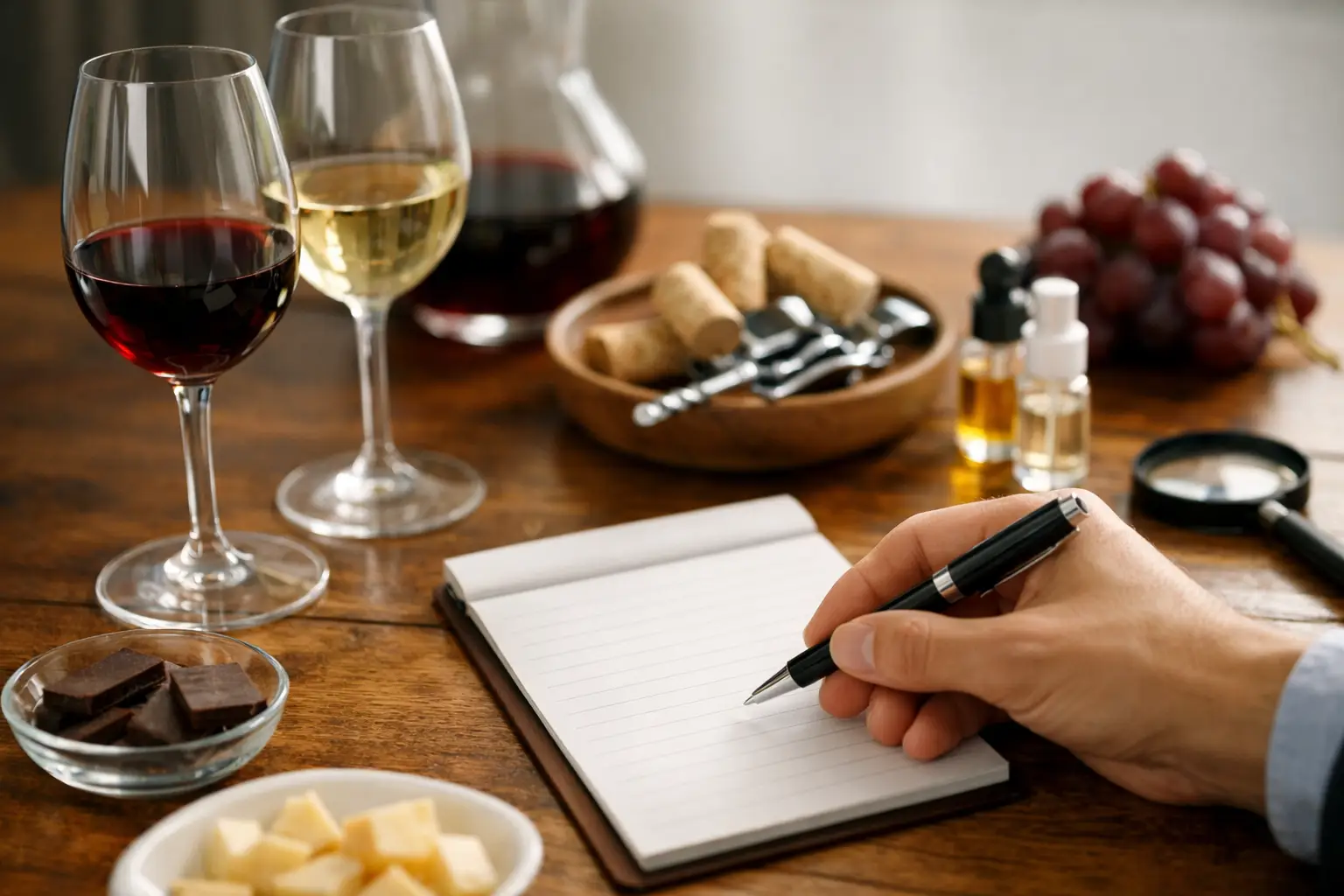
You do not need a perfect palate to write a useful tasting note. What makes a good tasting note is not showing off with rare descriptors or sounding like a critic. It is capturing enough honest detail that, weeks later, you can remember the glass, understand your own preferences and compare it with confidence.
That matters more than most people realise. A bottle can feel memorable in the moment, then vanish into a blur of “quite nice” or “a bit oaky” once the evening is over. A good note turns a passing impression into something you can return to. It gives shape to what you tasted and helps build better tasting language over time.
What makes a good tasting note in practice
A good tasting note is clear, specific and personal without becoming vague or theatrical. It helps answer three simple questions: what did I notice, how did it feel, and would I choose it again?
The best notes balance observation with usefulness. They say enough to be meaningful, but not so much that they become cluttered. If your note reads like a performance, it will not help you later. If it is too brief, it will not help either. “Lovely red” is pleasant, but it tells you almost nothing. “Fresh cherry, dried herbs, medium body, soft tannin, better after ten minutes in the glass” is much easier to revisit.
There is also a practical side to this. Good notes are comparable. If you write in a consistent way, you start to notice patterns across wine, whisky, beer and other spirits. You may realise that you often enjoy higher acidity in white wine, that peated whisky works better for you in smaller pours, or that certain beers appeal more for texture than aroma. That is where tasting notes stop being a diary and start becoming a useful memory system.
Start with structure, not fancy vocabulary
Many people assume a tasting note becomes “good” when it sounds technical. Usually the opposite is true. The strongest notes tend to follow a simple structure and use language you would actually use again.
A reliable note often moves through appearance, aroma, palate, texture and finish. You do not need to treat each part as a formal exam. The value lies in giving your attention somewhere to go. Instead of trying to describe everything at once, you notice one layer at a time.
Appearance is brief, but still useful
For wine, sparkling wine and beer, appearance can give context. Colour, brightness and intensity can be enough. For spirits, appearance often matters less unless there is something especially noticeable. The key is not to overwork it. “Pale straw, bright” is more useful than a dramatic paragraph about sunlight and gold.
Aroma tells you where the experience begins
A good note nearly always includes aroma because smell carries so much of flavour. This is where specificity helps. Fruit, floral, spice, oak, earth, smoke, nuts, herbs, pastry, citrus peel - these families are often enough. You can be more precise if it feels true, but precision should come from confidence, not pressure.
If you smell pear rather than “orchard fruit”, write pear. If it reminds you of lemon sherbet or toasted almonds, write that. Your own references are valid if they are recognisable and honest.
Palate and texture make the note useful
This is where many notes become either too broad or too dramatic. A good note captures what happens in the mouth with plain clarity. Is it dry or sweet? Light or full? Crisp, creamy, silky, lean, oily, velvety, sharp? Is the alcohol warming, integrated or a bit hot? Are tannins firm or gentle? Is the mousse soft or energetic in sparkling wine?
Texture matters because two drinks with similar flavours can feel completely different. One Chardonnay may show citrus and stone fruit with a taut, mineral feel, while another offers similar fruit with a rounder, buttery texture. If you only note flavour, you miss half the reason you preferred one over the other.
Finish separates a passing impression from a memorable one
The finish is not just whether flavour lasts. It is how it ends. Clean, savoury, spicy, drying, smoky, bitter, saline, warming, elegant, abrupt - these are all useful clues. A short finish is not automatically bad, and a long finish is not automatically good. It depends on balance and style. What matters is whether the ending feels pleasant, coherent and worth remembering.
Specific beats impressive
One of the clearest answers to what makes a good tasting note is this: specificity beats impressive language almost every time.
There is nothing wrong with advanced terminology when it is accurate. The problem comes when words are chosen to sound expert rather than to communicate. A note should help your future self, not an imaginary judging panel.
That means “ripe blackcurrant, cedar and a dry finish” is better than “an opulent symphony of dark forest fruits with aristocratic wood influence”. The first tells you what was there. The second tells you the writer wanted to sound grand.
A useful test is whether you could hand your note to a friend and they would understand the style of the drink. If yes, you are doing well.
Honesty matters more than correctness
Tasting can feel intimidating because people worry about getting it wrong. In practice, a good note does not need to be objectively perfect. It needs to be honest and attentive.
Your experience may not match somebody else’s note exactly, and that is normal. Glassware, serving temperature, food, mood, timing and even the room itself can shift what you notice. A whisky poured just after a spicy meal will not present itself the same way as one tasted quietly on its own. A white wine straight from the fridge may hide detail that appears ten minutes later.
That is why context can improve a tasting note. A short mention such as “opened up after air” or “better slightly warmer” can be surprisingly useful. So can “tasted with food” or “more expressive on the second pour”. These details are practical, not fussy.
Good tasting notes include judgement, but not only scores
A note becomes more helpful when it includes your verdict. Not a number for the sake of it, but a sentence that explains your response. Did you enjoy it? Would you buy it again? Is it better for slow sipping than casual drinking? Would you choose it for a weeknight, a dinner table, or a special bottle share?
This is the part many people forget, yet it is often the most useful later. Sensory description tells you what the drink was like. Judgement tells you what it meant to you.
If scoring helps you stay consistent, use it. If not, a short preference statement works better than a forced rating. “Good value, fresh and easy, but not very complex” is clear. “Excellent with hard cheese” is clear too. Taste is personal, and your note should leave room for that.
What to avoid when writing tasting notes
Most weak tasting notes fail in predictable ways. They are too vague, too crowded, or too borrowed from other people’s language.
Vagueness is the most common problem. Words like “nice”, “smooth” and “strong” are not wrong, but they need support. Smooth in what sense? Low burn, soft texture, rounded tannin? Strong in alcohol, flavour or finish?
Overwriting is another issue. When every sip becomes a poetic event, the note loses practical value. You are not trying to prove that the drink is special. You are trying to record what you noticed.
Borrowed language can be just as unhelpful. If a tasting note is full of descriptors you would never naturally identify, it will not strengthen your confidence. Better to write three true things than ten borrowed ones.
How your notes improve over time
No one writes great tasting notes by accident. They improve through repetition and comparison. That is why consistency matters more than brilliance.
If you use a similar rhythm each time, you begin to trust your own observations. You notice that your “fresh citrus” often points towards high acidity. You spot the difference between oak flavour and oak texture. You learn that what you once called “strong” is sometimes simply concentrated, youthful or dry.
Comparative tasting helps even more. A single note can be useful, but two notes side by side are often where learning sharpens. Put one Sauvignon Blanc against another, or compare a peated whisky with an unpeated one, and your vocabulary develops faster because contrast gives definition.
This is also where a saved record becomes valuable. Memory is selective. We often remember labels, prices and occasions more clearly than aroma or finish. A structured note gives you something better than memory alone. It creates continuity between bottles and helps future choices feel less random. That is one reason platforms such as Audio Sommelier focus on guided tasting and note saving together rather than treating tasting as a one-off moment.
A simple standard to use every time
If you want a practical standard, ask whether your note does four jobs. It should describe the drink clearly, capture how it feels, record your judgement and leave enough detail to compare it later.
That does not require expert-level language. It requires attention. A good tasting note might be six lines long or two short paragraphs. It might mention green apple, chalky texture, lively acidity and a clean finish, then add that you would happily buy it again for seafood or warm-weather drinking. That is enough. It is clear, useful and personal.
The real goal is not to sound like somebody in the trade. It is to make your own taste easier to understand. Once that starts happening, every bottle becomes a little more rewarding, and every note becomes a small step towards first sip confidence.